By Shumirai Chimombe
Leaders Unanimously Adopt The New Delhi Declaration
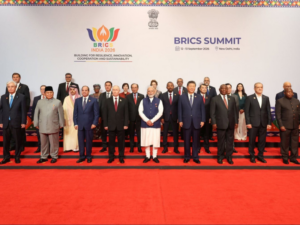
The 18th BRICS Summit, which took place from 12 to 13 September concluded with leaders unanimously adopting the New Delhi BRICS Leaders’ Declaration which sets out the shared priorities, commitments, and direction for cooperation going forward.
With India as the current BRICS Chair with Prime Minister Narendra Modi at the helm, the Summit took place in New Delhi under the theme: “Building for Resilience, Innovation, Cooperation and Sustainability.” It brought together Heads of State from the 11-member bloc of emerging markets and developing countries including Brazil, China, Egypt, Ethiopia, India, Indonesia, Iran, Russia, Saudi Arabia, South Africa and the United Arab Emirates.
Representatives of the BRICS partner countries and Heads of international organisations including UN Secretary General António Guterres, were also present. During a media briefing at the end of the Summit on 13 September, President Cyril Ramaphosa congratulated India for hosting a successful gathering.
“What really stood out was our commitment, as BRICS, to focus on advancing global governance of the multilateral system”, he said. “All of us are saying that we adhere to a multilateral system where there is no dominance of one player or country over others; where we want countries that are in BRICS, and indeed countries outside of BRICS as well, to respect one another and to respect the sovereignty of all our countries in the world.”
He said that the BRICS leaders all confirmed that they want a multipolar world, a world that will live in harmony and that will advance the interests of everyone. “And that, to me, was the key and central issue because we now live in a world that faces a lot of challenges and conflicts at the geopolitical level.”
The New Delhi Declaration – Building for Resilience, Innovation, Cooperation and Sustainability
The New Delhi Declaration opened with the leaders reaffirming their commitment to the BRICS spirit of mutual respect and understanding, sovereign equality, solidarity, democracy, openness, inclusiveness, collaboration, and consensus.
“Building on two decades of BRICS, we further commit ourselves to strengthening cooperation in the expanded BRICS under the three pillars of political and security, economic and financial, cultural and people-to-people cooperation, and to enhancing our strategic partnership for the benefit of our people through the promotion of peace, a more representative, fairer international order, a reinvigorated and reformed multilateral system, sustainable development and inclusive growth.”
The leaders also recognised the valuable contribution of partner countries to BRICS cooperation and reiterated their commitment to fostering inclusive, mutually beneficial and development-oriented partnerships. The BRICS partner countries are Belarus, Bolivia, Kazakhstan, Cuba, Malaysia, Nigeria, Thailand, Uganda, Uzbekistan and Vietnam.
On Inclusive Global Governance and Multilateralism
The Declaration reaffirmed its commitment to reforming and improving global governance by promoting a more equitable, representative, and democratic international multilateral system in the spirit of extensive consultation, joint contribution and shared benefits.
“We reiterate our commitment to strengthening multilateralism and multipolarity and to upholding international law, including the Purposes and Principles of the Charter of the United Nations in their entirety and interconnectedness in a balanced and inclusive manner, as its indispensable cornerstone…”
The leaders stated that in the context of the contemporary realities of the multipolar world, it is crucial that developing countries strengthen their efforts to promote dialogue and consultations for more just and equitable global governance and mutually beneficial relations among nations.
“We acknowledge that multipolarity can expand opportunities for EMDCs (Emerging Markets and Developing Countries) to develop their constructive potential and enjoy universally beneficial, inclusive, sustainable and equitable economic globalization and cooperation. We highlight the importance of the Global South as a driver for positive change, especially in the face of significant international challenges, including deepening geopolitical tensions, rapid economic downturns and technological changes, protectionist measures, migratory challenges, and climate change.”
With the growing share of EMDEs ( Emerging Markets and Developing Economies) in global output and growth, reform of global economic governance remains a consistent BRICS priority. The leaders pledged to continue to strengthen coordination among BRICS members to make international financial institutions more representative, transparent and accountable.
“We reiterate the urgent need to reform the Bretton Woods Institutions (BWI) to make them more agile, effective, credible, inclusive, fit for purpose, unbiased, accountable, and representative, to enhance their legitimacy. BWI governance structure should be reformed to reflect the transformation of the global economy since their establishment. The voice and representation of EMDEs in the BWI must reflect their relative position in the global economy.”
On ICT
The leaders recognised that digital and ICT ecosystems are a critical foundation for economic development, social inclusion, improved service-delivery, sustainable growth, resilience and innovation.
“We encourage enhancing cooperation in digital skilling, research cooperation and capacity building through scalable, context-responsive and collaborative approaches. In this regard, we note the proposal for the capacity building centres for BRICS member states as a commendable effort towards fostering a future-ready workforce.”
On Health
The leaders embraced the deepening cooperation in global health initiatives and reaffirmed their commitment to advancing universal health coverage through resilient, inclusive, and people-centred approaches. “We recognise the significance of continued cooperation among the BRICS members and the necessity of sharing valuable experiences, innovations and best practices for improving health outcomes across the BRICS countries.”
On Food Security
The Declaration highlighted the importance of ensuring food security and nutrition and mitigating the impacts of acute food price volatility, as well as abrupt supply crises including fertilizers shortage.
“We support further discussions on national policies and on international coordination that enhance food availability, accessibility, utilisation, stability and affordability, as well as relevant agricultural and food production inputs in BRICS and other developing countries – including those that strengthen national capacities to respond to supply disruptions, such as national food reserve systems, and drought resilient and climate adaptive seed systems. We also look forward to discussions on facilitating intra-BRICS trade of agricultural products, and agricultural and food production inputs, including by promoting resilient and non-discriminatory supply chains, and improving value chains and sustainable agricultural practices.”
On Disaster Risk
“While acknowledging the growing complexity of disaster risks, including those related to climate change especially for the Global South, we reaffirm our commitment to BRICS cooperation to improve national disaster risk reduction systems and capacities to reduce disaster-related damage and protect infrastructure, human lives and livelihoods; to share traditional, indigenous, local knowledge and community-based approaches, to ensure preparedness and self-reliance; as well as to mobilise adequate, predictable and accessible financing, including public and private investment, for comprehensive infrastructure development.”
On Trade Cooperation
The Declaration highlighted the willingness to harness the potential of the Special Economic Zones (SEZs) of the BRICS members, as well established mechanisms, for promoting trade, investment, industrial cooperation, innovation, and integration into resilient and sustainable global value chains (GVCs), by providing enterprises with an enabling business environment, efficient infrastructure, streamlined regulatory procedures, and other facilitative measures that enhance ease of doing business.
“We aim to build cooperation in connectivity and trade facilitation inter alia digitisation of trade documentation for stakeholders to operate in a more efficient, transparent, and seamless environment, taking into consideration different capacities of each BRICS member.”
On Tourism
The leaders acknowledged that the BRICS countries have immense potential in the tourism sector and offer significant opportunities for the growth and development of sustainable and resilient tourism, in line with the Sustainable Development Goals, including through the promotion of ecotourism.
“We encourage knowledge exchange on responsible, sustainable and regenerative tourism models. We welcome the initiatives on harnessing Artificial Intelligence and digital tools for smarter, more efficient tourism systems; such as digital payment systems promoting eco-friendly, community-led, sustainable and climate-resilient tourism models; strengthening human capital, training, promotion of investment and institutional capacity across the sector; and facilitating smooth tourism flows.”
The grouping commended India’s BRICS Chairship in 2026 and extended its full support to China for its BRICS Chairship in 2027.
Indian Prime Minister Narendra Modi wrote that the New Delhi Declaration, adopted unanimously at the 2026 BRICS Delhi Summit on 12 September, reflects the confidence of a BRICS that is wider in reach and stronger in purpose.
“With a focus on innovation, sustainability, people-to-people ties and more, the endeavour is to make cooperation more practical, development-oriented and responsive to the aspirations of the BRICS nations. I thank all the fellow BRICS nations and their leaders for its adoption.”
The full New Delhi Declaration can be read and downloaded on the DIRCO website and the Government of India Ministry of External Affairs website
Sources: South Africa Government News Agency | BRICS India | Government of India Ministry of External Affairs