By Shumirai Chimombe
“Sea surface temperatures in the central and eastern tropical Pacific are forecast to increase to record levels during October-November-December 2026, reflecting the strengthening of the El Niño event which will drive weather patterns and impact economies, ecosystems and communities across the globe. It will continue to intensify ahead of its forecast peak in December. It is likely to bring above-average temperatures to much of the globe and shift rainfall patterns, increasing the risk of drought and floods in different regions.” World Meteorological Organisation (WMO)
What Does This Mean For South Africa?
The South African Weather Service (SAWS) reported in a statement on 1 September that the latest predictions are indicative that the El Niño will likely intensify further to become the strongest event in living memory. A strong El Niño refers to an event where 3-monthly averaged sea surface temperature anomalies over the eastern central tropical Pacific Ocean exceed 1.5°C, while during a very strong El Niño, this part of the ocean is 2°C warmer than normal. The latest forecasts indicate that the current event will very likely exceed the 3°C threshold.
According to the weather service most El Niño events bring below-normal rainfall and above-normal temperatures to the southern African region. Two of the most impactful El Niño events for the region were those of 1982/83 and 2015/16, which brought widespread drought. However, the very strong El Niño event of 1997/98, came with slightly above-normal rainfall over parts of South Africa’s summer rainfall region.
“It should therefore be noted that, although below-normal rainfall is statistically the most likely outcome in southern Africa this summer, not every El Niño event is associated with drought.”
The seasonal forecast for November 2026 to March 2027 produced by SAWS indicates an increased likelihood of below-normal rainfall across large parts of the summer rainfall region, particularly across the interior and the north-eastern half of the country, where substantial rainfall is normally received during summer.
“It should be noted that the expected very strong 2026/27 El Niño event, combined with global warming, will likely result in 2027 being the warmest year ever recorded. The 2015/16 very strong El Niño event brought unprecedented heatwaves to the southern African region.”
The region has continued to warm in the 11 years since then.
“If the 2026/27 El Niño event brings the expected below-normal rainfall to southern Africa, it is likely that a high frequency of heatwaves will co-occur. These heatwaves have the potential to be severe. However, as current forecasts indicate the potential for an exceptionally strong El Niño, uncertainty remains regarding its eventual strength and regional impacts.
“For this reason, the extent of expected heatwaves and water scarcity associated with the event will be closely monitored and communicated among Disaster Management structures, weather sensitive industries, the media and the public.”
Impact on Health
Speaking to SABC News, Prof Francois Engelbrecht, Director, Global Change Institute at Wits University said that the biggest risk this summer is the effect that these heatwaves will have on people living in informal housing.
“I would say that’s our number one risk because we are currently also facing infrastructure issues in terms of water supply. Now when you are living in informal housing, you are facing a heatwave that lasts 10 to 14 days and the maximum temperature goes above 35° C. If you face that type of heat in informal housing and at the same time you don’t have easy access to cool water, this is literally a life-threatening situation. So we need to think about how we are going to ensure water supply to the most vulnerable people during times of these heatwaves.”
SAWS has urged health authorities to use its Seasonal Outlook to strengthen preparedness for heat and potential water shortages, with particular attention to vulnerable communities – including women, children, older persons, persons with disabilities and communities living in high-risk areas – and to ensure the continuity of water, sanitation and health services. SAWS also highlighted that public communication should emphasise adequate hydration, reduced exposure to excessive heat, access to cool or shaded spaces, responsible water use, and safe water and hygiene practices.
Early Action and Disaster Management
National Disaster Management Centre (NDMC) Director for Disaster Risk Assessment and Early Warning, Pumeza Tyali has stressed that official weather forecasts should not remain as just technical information. They must be turned into practical action that reaches communities before hazards become disasters.
She said that the NDMC is continuously coordinating efforts to bring resilience in the communities and monitoring the risks that are associated with El Niño. Early risk monitoring, contingency planning and coordination between national, provincial and local disaster management structures will be critical to reducing vulnerability during the season.
“Preparedness must begin before the impacts are felt. This includes tracking hazards, identifying exposed areas, reviewing contingency plans and ensuring that warnings lead to practical measures on the ground.
She explained that: Water and sanitation authorities are monitoring demand management and planning for possible drought conditions, while the agriculture sector is supporting farmers with timely advisories on crops, livestock, water availability and food security risks.
The health sector is also stepping up its preparedness efforts including surveillance for water-related diseases, heat-related illnesses, and other community health concerns that may arise during periods of high temperatures and reduced rainfall.
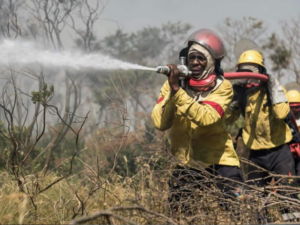
Provincial and local disaster management centres, together with fire and emergency services, are preparing through fire readiness measures, contingency plans, awareness campaigns and public information programmes.
The message from the NDMC is clear: early planning, coordinated response and clear communication can help protect lives, livelihoods and essential services during the season.
Impact On Agriculture
In an interview with SABC News, AgriSA CEO Johann Kotze gave some valuable insights into what El Niño could mean for South African agriculture.
He indicated that although the current situation is a major concern to farmers, particularly grain farmers on dryland, it was highly important to emphasise that there is no immediate threat to food security.
“We had a fantastic two years. The prediction is we’re going to have the highest stock levels ever for grains, soya beans, sunflower, ground nuts. And that’s about 21.6-million tons. So it’s a massive opportunity for carryover stock up to next year. I think we would be in good standing with food security. If we look at the water table, we had some good rains. We didn’t have a dry spell before this El Niño, so at least there’s a bit of a leeway for us.”
In terms of what measures farmers can take to mitigate the risk of an El Niño, Johann said that there are means and ends for the big commercial farmers to do this. However, the greatest concern is for medium-sized and small-scale farmers not being able to cope with El Niño. This is because in addition to high fertilizer prices and high fuel prices, they will have the devastation of not being able to plant or to buy into tech to help mitigate the risk.
The Department of Agriculture said in its El Niño Advisory in September that it will continue to monitor conditions and provide updates through early warning information such as its regular advisories and daily extreme weather warnings. The Department at both provincial and national level will partner with all relevant stakeholders to continue raising awareness in the sector, and assist farmers in understanding, interpreting and utilising early warning information for disaster risk mitigation and response.
On Water Security Management
According to Johann Kotze, South Africa is currently in good standing with dams being either full or nearly full. However, he expressed his concern about how the water is stored and managed, with significant wastage of water being a major issue. Therefore priority needs to be given to improving the country’s water storage capacity. However, within the very real concerns and negativity associated with El Niño, Johann said that there was the opportunity to identify areas of weakness and lessons to be learned.
“What we’ve seen with El Niño is that it actually reveals the gaps we have to be self-sufficient in food security and the gaps we have in how we manage water in South Africa. I think we should not let go of the opportunity of what El Niño is actually showing us in terms of water capacity, the storage of water, and the management of water.”
Sources: South African Weather Service (SAWS) | SABC News | Department of Agriculture | World Meteorological Organisation